
It is easy to think of Edward Henry Potthast as a painter of beaches. The association is understandable. Again and again, he returned to the shore, where children played in the water, families gathered on the sand and umbrellas and hats stood out against the summer light. But the beach was only one part of his subject matter and the way he painted it grew from a much longer artistic education.
Potthast was born in Cincinnati in 1857. He studied at the McMicken School of Design and worked as a lithographer before spending several years studying in Europe. His travels included Antwerp, Munich and Paris. Those places mattered. His early training was more closely tied to academic traditions, while his later work became increasingly concerned with the lighter palette and outdoor effects associated with Impressionism.
The difference can be seen in the mature paintings. Potthast wasn't trying to reproduce a Parisian street or a French garden. He took ideas he had encountered in Europe and applied them to places and experiences familiar to Americans: the public beach, the New England coast, Central Park, children playing outdoors. That change of subject is important. The "American" in American Impressionism isn't simply a matter of where the painter happened to live. It also reflects the new kinds of modern life American artists chose to put on canvas.
A long way to the shore
Potthast's years in Europe gave him a solid grounding in drawing, painting figures and constructing a composition. Munich was an important part of that education. The Munich tradition placed considerable emphasis on form, modeling and tonal values.
Paris opened another possibility. Potthast exhibited at the Paris Salon from 1889 to 1891 and during his time in France he encountered the newer approaches to painting that were changing the way artists looked at landscape and modern life. The Cincinnati Art Museum identifies his visits to Paris in the 1890s as an important point in his introduction to Impressionism.
His later paintings don't abandon the discipline of his earlier training. They simply handle it differently.
A figure might be reduced to a few strokes. A patch of sunlight can do some of the work that careful modeling once did. Instead of describing every object with the same degree of precision, Potthast could let some areas remain loose while allowing the larger arrangement to hold together.
That balance becomes important when looking at his American scenes.
Sunlight on the beach
Consider A Day at the Beach. The first impression is one of leisure, but the painting is also busy with small changes of light and color. People are spread across the shore. The water extends the composition outward. The sky leaves the upper part of the scene open.
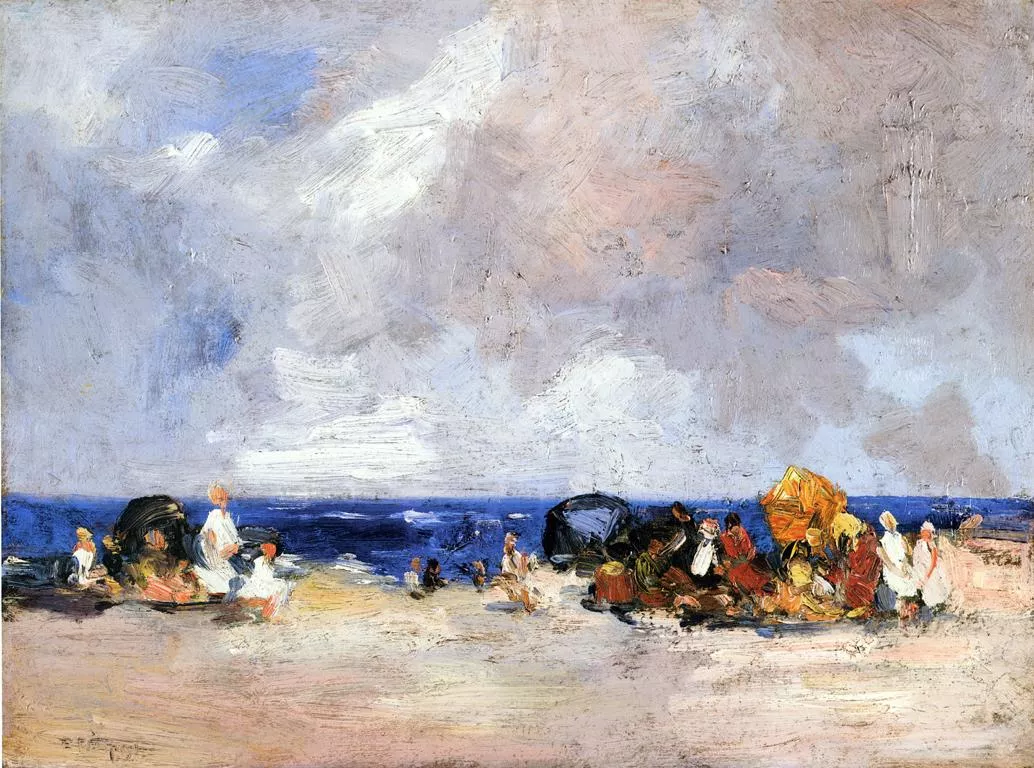
Potthast had found a subject in which Impressionist concerns came naturally. Sunlight is constantly changing at the seaside. White clothing isn't simply white. Sand takes on different colors depending on its position in the light. Water reflects the sky, nearby figures and the movement of the surface.
The Cincinnati Art Museum has described Potthast's mature paintings as sun-filled and has drawn attention to details such as hats and umbrellas. These small, light-colored forms recur in his beach imagery and help break up broad areas of sand and water.
There is also a sense of movement. People aren't posed for a formal group portrait. They walk, sit, bathe, talk or watch the water. The painting belongs to a particular kind of American leisure that became increasingly familiar around the turn of the twentieth century.
The scene is casual. The painting is carefully organized.
Beyond the beach
Potthast's interest in outdoor light wasn't limited to summer crowds. The Maine Coast shows another side of his landscape painting, where the presence of people becomes less important and the coastline itself takes over.
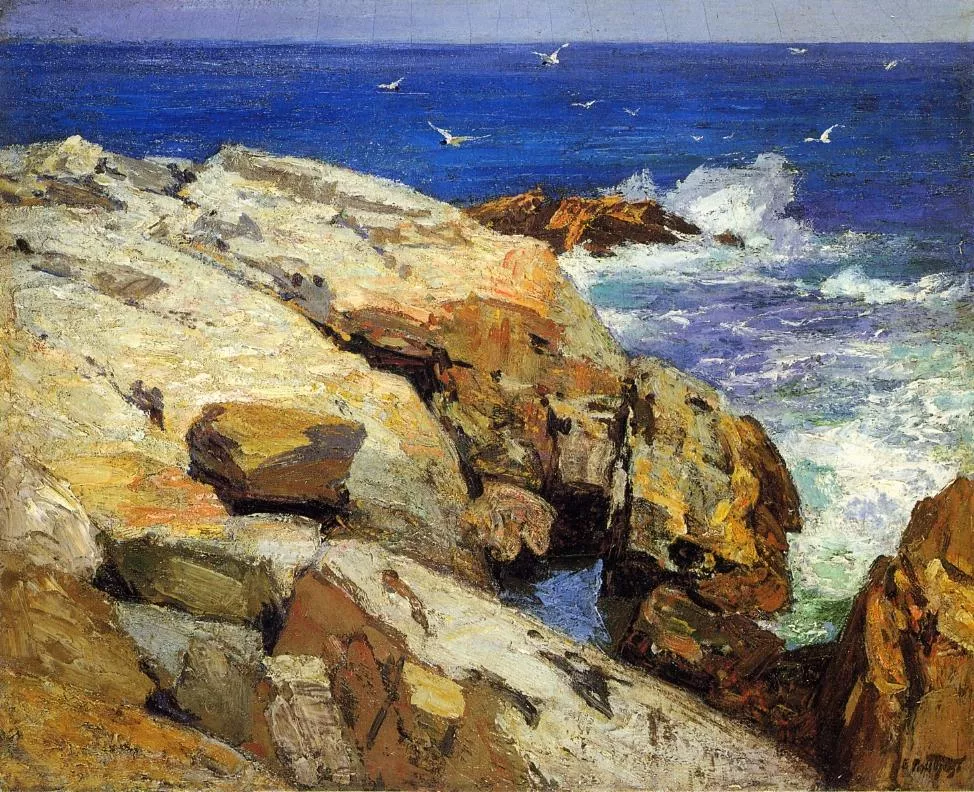
Maine offered a different visual problem. There is rock, water, sky and a long horizon. The forms are more substantial than those of a beach crowded with holidaymakers. Light still matters, but the mood changes with the subject.
Potthast spent summers painting along the New England coast and these coastal subjects became an important part of his work. His paintings also extended into other parts of the American landscape. The Cincinnati Art Museum's exhibition devoted to Potthast included harbor scenes, landscapes, portraits, European subjects and scenes of rural work alongside the better-known beach paintings.
So "American Impressionism" in Potthast's case shouldn't be reduced to one formula. The same attention to light could be applied to very different places.
A coastline. A city park. A summer crowd.
Children at play
People often become the brightest points in Potthast's compositions, especially when he paints children.
In Girls Playing in Surf, the children are surrounded by water and open sky. Their figures give the scene a sense of scale, but they also provide its movement. The eye moves from one small body to another and then outward toward the larger space around them.
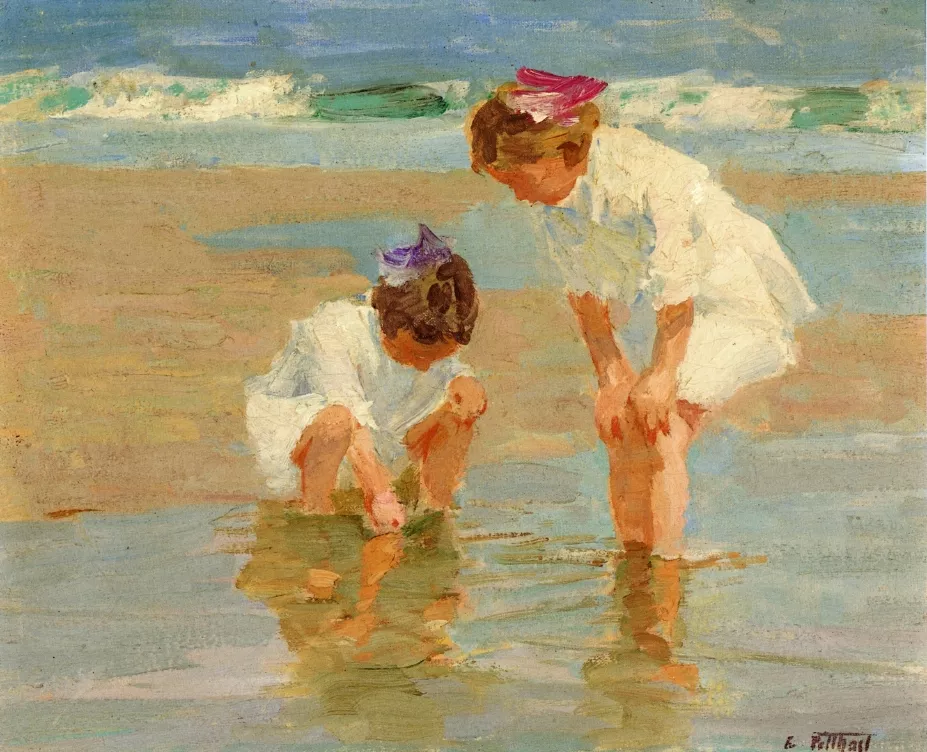
Potthast returned frequently to children playing outdoors. It was a subject that allowed him to avoid the stiffness of formal portraiture. Children run, splash, gather together and change direction. Their poses are temporary.
That quality suits his Impressionist approach.
A painter interested in fleeting effects of light is also well served by fleeting human gestures. Neither stays still for long.
The Cincinnati Art Museum has described Potthast's beach scenes as images of Americans enjoying the shore. Looking through the wider group of his paintings, that interest in ordinary activity becomes more apparent. This is important to Potthast's American subjects. The people aren't presented as isolated figures with a story that needs to be explained. They belong to the beach, the park or the water. Their presence tells us how these public spaces were used, while their small scale allows the landscape and light to remain equally important.
New York outdoors
Potthast could find much the same combination of people, light and landscape in the city.
By 1908 he had a studio in the Gainsborough Building overlooking Central Park, according to the Metropolitan Museum. He painted the park repeatedly. In Central Park therefore makes an interesting comparison with the beach pictures. The setting has changed completely, but the open-air quality remains.

Central Park gives him trees, paths, lawns, water and groups of people rather than sand and surf. It also creates a more enclosed space. The horizon isn't the dominant feature. Instead, the eye moves through the park from one area to another.
Potthast's career in New York had begun earlier. He worked as an illustrator for magazines before concentrating increasingly on painting. He was elected an Associate of the National Academy of Design in 1899 and became a full Academician in 1906.
The city offered plenty of subjects, but Potthast continued to look for scenes where people could be observed outside. His parks and beaches share that basic interest in unforced activity.
Finding his own Impressionism
Potthast's relationship with Impressionism is interesting precisely because it wasn't the starting point of his career. He arrived at it after academic study, lithography, European travel and years of work.
That background helps explain why his paintings can feel more structured than the loose brushwork might first suggest. Figures are scattered across the beach, but they aren't scattered randomly. Areas of color balance one another. Groups of people create visual weight. The shoreline guides the eye.
The sunlight does the rest.
In the beach paintings, Potthast found a subject where his interests could come together. Color could shift in the open air. Figures could remain informal. Water could provide movement across the surface of the canvas. A familiar American setting could become an opportunity to study the changing appearance of a single moment.
His paintings of the coast and Central Park show that this wasn't confined to one location. The same eye could move from the Atlantic shore to a New York lawn and find something worth painting.
Perhaps that is the most useful way to approach Edward Henry Potthast today. Not simply as the painter of cheerful beach scenes, but as an artist who spent much of his career looking for places where light and everyday life met. The people in his paintings are rarely monumental. They are walking, playing, resting or watching the water. For a moment, the ordinary world is enough.
Clara Whitmore writes about American painting and Impressionism, with a particular interest in the relationship between everyday life, landscape, light and the viewer's gaze. Her editorial work focuses on making paintings approachable while preserving the details that give each work its character.